
Pest and wildlife advice
Should honey bees in a wall, roof or tree be removed?
Not all bee activity calls for removal. This location-based guide helps you decide whether to keep clear of a temporary cluster or request identification and an assessment of a possible nest in a wall, roof or tree.
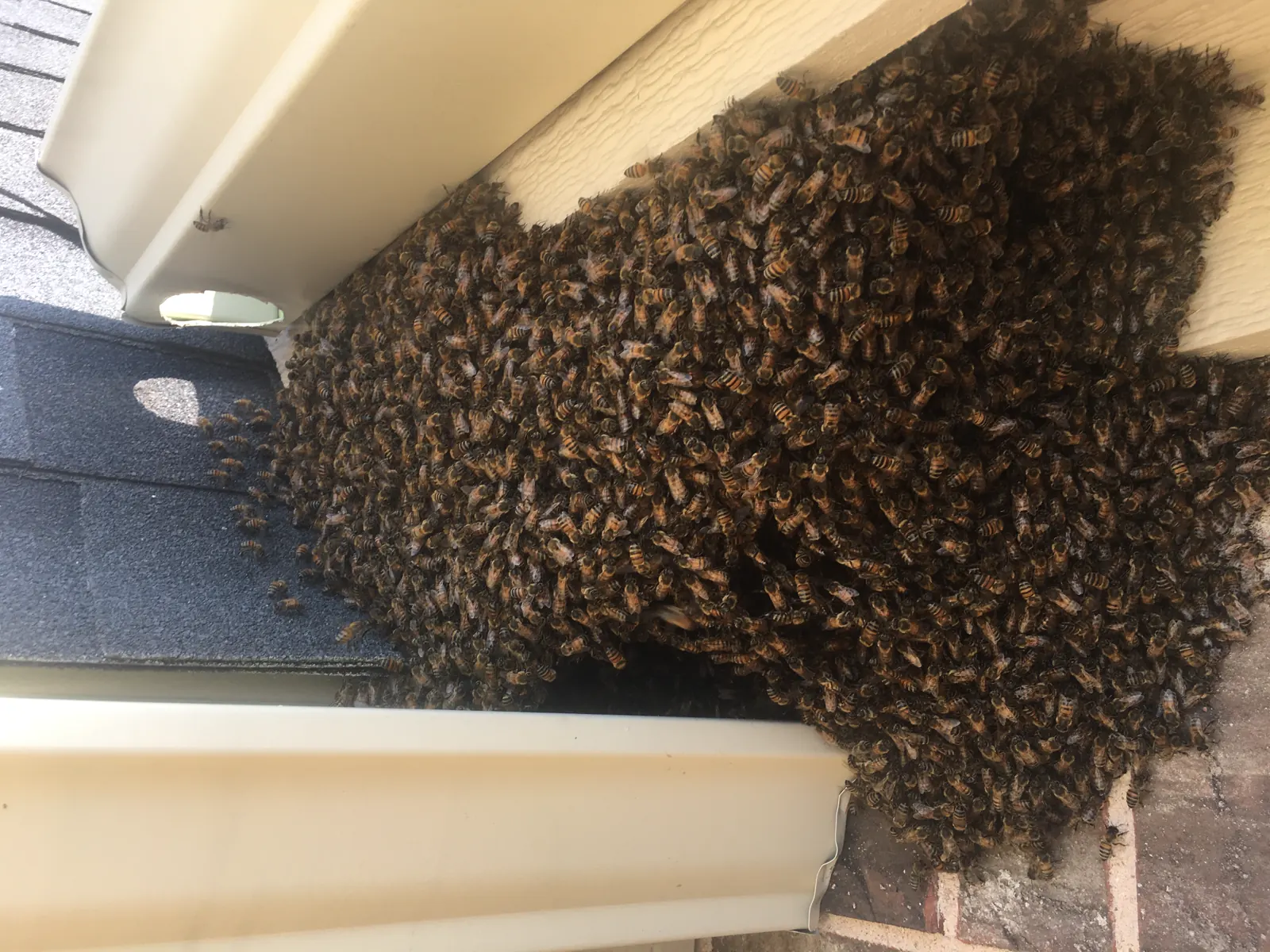
Seeing bees around your house does not always mean a colony lives inside it. Where the bees are and what they are doing tell you more than their presence alone. This guide covers one decision. You can keep your distance and watch a temporary cluster, or you can ask for identification and an assessment of possible nesting activity.
First, identify what the bees are doing
Bee activity around a home usually fits one of these patterns:
- Foraging. Bees move between flowers to collect food and do not settle in one spot.
- A resting cluster. A swarm is a group of bees that has left a crowded colony to look for a new home. It gathers on a tree limb, shrub or other object and usually stays for an hour to a few days, according to Iowa State Extension.
- Repeated traffic at an opening. Insects flying in and out of the same gap in a wall, roofline or tree trunk may mean a nest is inside a hidden space.
Texas A&M AgriLife notes that wasps are more often a problem around homes than honey bees, though bees do sometimes swarm or build nests near homes and even inside walls. Appearance can mislead. Iowa State Extension reports that about 90% of the inquiries it receives about "bees" in the ground or in a house wall turn out to be yellowjacket wasps. Honey bees are fuzzy and golden brown, and yellowjackets are shiny yellow with black markings, but the two are easy to confuse. The difference matters because yellowjacket colonies last one season, while a honey bee nest may last many years and store honey inside the wall (Iowa State Extension).
When a tree cluster can be left alone
A swarm hanging from an exposed branch is usually temporary. Iowa State Extension says that in most cases you do not need to do anything, because the bees will move on. Stay back and keep others away. Swarming bees are away from their nest and stored food, so they are less defensive and unlikely to sting unless provoked (Iowa State Extension).
A cluster's location can change that advice. If it sits somewhere that creates a serious health threat, such as a heavily used area, an experienced beekeeper may be willing to collect and relocate it. Some charge a fee for this.
Bees entering a hole in a tree trunk are a different situation. Honey bees nest in natural cavities, including hollow trees (NC State Extension), and a hollow tree is one of the sites a swarm may choose for a new colony (Iowa State Extension). Traffic into a trunk opening may point to an established colony instead of a passing swarm. In our view, if that tree stands near a door, play area or path that people use daily, it is worth asking for an assessment of how the colony affects the use of that space.
When wall or roof activity warrants an assessment
Repeated traffic into a gap in an exterior wall, a soffit or an opening near the roof or attic deserves professional identification. That traffic alone does not prove a honey bee colony is inside, and it does not tell you where a nest might be. An assessment can confirm which insect it is and whether a colony occupies a building cavity.
NC State Extension states that honey bees do not cause direct structural damage. The risk comes from what an established colony leaves behind. A colony builds wax comb and stores honey, and NC State Extension notes a wall may hold as much as 40 pounds of honey by the end of spring. If the colony is killed and that material stays in place, the honey can ferment and discolor or damage walls, and it can feed other pests such as ants and cockroaches. Dead bees can also lead to carpet beetle infestations. Iowa State Extension adds that honey and wax left in a wall void can ruin walls and ceilings.
A hypothetical example
This example is hypothetical. A homeowner notices insects flying into a small gap beside the trim on an exterior wall. The traffic continues for several days, mostly in the warm part of the afternoon.
The observation shows steady use of one opening. It does not show whether the insects are honey bees or yellowjackets, where inside the wall a nest might be, or how large it is. Sealing the gap would be a guess, and it could push active bees toward the inside of the house.
The homeowner leaves the gap open, notes the location and the times of activity, and requests an assessment before anyone closes the opening or treats the area.
What to ask before agreeing to removal
Use these questions when you talk with a beekeeper or pest control provider:
- Has the insect been confirmed as honey bees, and has the nest location been found?
- Is relocating the colony an option for this site?
- Will access require opening the wall or ceiling?
- Who handles repairs after the wall or ceiling is opened, and is that part of the agreement?
- Will the work remove the comb and honey, or only the bees?
- How long might the process take, and what fees apply?
- Is the person you hire insured?
- Are they registered with the Texas Apiary Inspection Service to perform this type of removal?
Do not close an active entrance yourself. Both extension sources warn that bees will find another way out and may end up inside the home. NC State Extension lists gaps in baseboards, outlets and vents as possible routes (NC State Extension).
Ask directly about relocation and repairs, because not every provider offers them. NC State Extension notes that removing a colony intact may mean cutting large holes in ceilings or walls, that repair may not be included in the removal contract, and that trapping rarely removes every bee. Iowa State Extension says trapping bees from a wall may take several weeks.
Ask what happens to the nest material. Removing or treating the bees without dealing with comb and honey can leave a problem behind, since leftover comb may attract scavengers and the wax may melt and leak honey (Iowa State Extension). If a colony is treated with insecticide, both sources say to discard the honey and comb instead of saving them.
Your next step
Currin Pest Control provides honey bee removal and inspections in Dallas, Ellis, Tarrant, Johnson, Rockwall and Kaufman counties in Texas. Currin Pest Control is licensed, insured, and registered with the Texas Apiary Inspection Services. Currin Pest Control also has been keeping bees since 2007 and currently has over 50 hives they maintain. Before you call anyone, write down where you see the activity, whether the bees are clustered in the open or entering an opening, and when it happens. If insects keep entering a gap in your wall or roofline, or a colony in a tree cavity affects how people use your yard, request identification and an assessment before anyone seals or treats the spot.